
Li-Fi – Wireless Internet Using Light (No, really!)

 This article is over six months old. Which means the information below may be out of date. Please keep this in mind whilst reading this article.
Streaming music or videos on your device without an internet connection, wi-fi or 3G card and only through the light of a lamp.
“That’s science fiction” I hear you call. Well no, not any more. We introduce to you, Li-Fi. It was presented at LeWeb 2012, an event devoted to connected objects. The Li-Fi (Light Fidelity) has been developed by Oledcomm, a French company.
How does Li-Fi work?
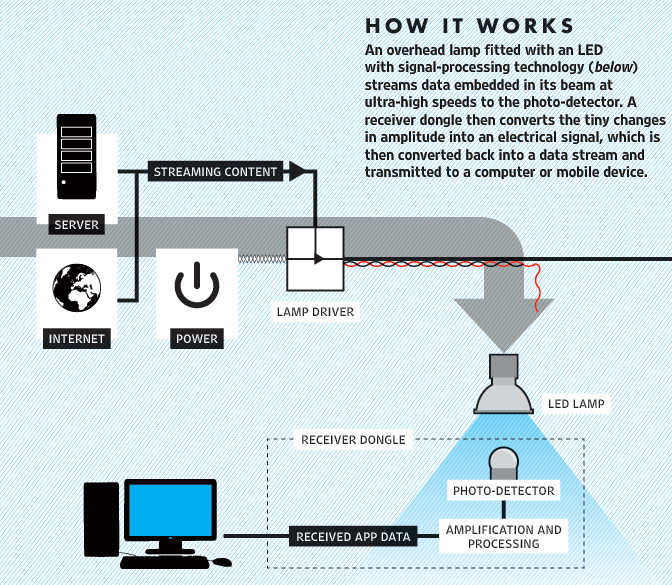
Li-Fi technology is a wireless communication system based on the use of visible light between the blue (670 THz) and red (480 THz). Unlike Wi-Fi which uses the radio part of the electromagnetic spectrum, Li-Fi uses the optical spectrum. The principle of Li-Fi is based on sending data by amplitude modulation of the light sources in a well-defined and standardized way.
The principle is simple: the LED turns on and off at high speed and is not visible to humans. This ribbon of on and off signals is interpreted to create binary streams of 0 and 1. Because there are no battling light frequencies like that of the radio frequencies in Wi-Fi, Li-Fi is thought to be 80% more efficient. Which means it can reach speeds of upto 1 Gbps. Is this the future?
Li-Fi differs from fibre optic because the Li-Fi protocol layers are suitable for wireless communication over short distances (up to ten meters). This puts Li-Fi in a unique position of extremely fast wireless communication over short distances. The technology has already attained IEEE standard certification and is currently being tested at the Oledcomm headquarters in France. It is expected that Li-Fi could be ready for use as soon as 2014.
Is Li-Fi the future, or will you be sticking with your good old fashioned radio waves? Why not tell us what you think in the comments below…
Click and Share ->
Get Free Updates



Pingback: Mobile World Congress (MWC) 2013 – Day III | RefuGeeks